Know who your friends are
Published by Nathan.McIntosh on Tue, 12/03/2013 - 16:14
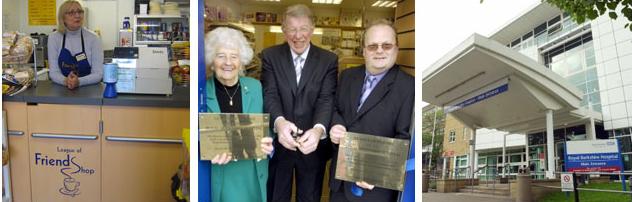
You’re bound to have come across them, and, if you haven’t already, you probably will. They’re the unpaid volunteers who run hospital coffee shops, bring round books, provide information, and chat to patients. Leagues of Friends are groups of volunteers who work in hospitals for patients and staff. They predate the NHS and have moved with the times.
A League of Friends is a volunteering organisation attached to a hospital (although some also work with primary care surgeries), and there are 1500 of them across the United Kingdom, linked via a national association called Attend. The members of the friends’ organisations volunteer, for example, in hospitals where they often run snack shops and book borrowing services as well as fundraising activities. In 2012 they raised £43m (€50m; $68m) for their hospitals. Each of the 30 000 volunteers gives an average of 3 to 6 hours of time each week. What is the League of Friends?
The Leagues of Friends seem to be a peculiarly British thing, explains David Wood, chief executive of Attend. “It’s not only a Brit thing, but if it’s not here it’s a bit expat,” he says. Leagues of Friends can also be found in Australia, Spain, and Africa. Where did they come from?
In the United Kingdom the Leagues of Friends grew from the linen leagues in infirmaries where doctors’ wives would get together and provide sheets for the beds of patients who couldn’t afford them. Voluntary hospitals, often run by Leagues of Friends, joined together in the 1800s to establish the British Hospital Association.
In 1948 the NHS was formed and the contribution that leagues could make came into question. As Wood explains, with the universal health coverage there was “an outcry from the voluntary sector about what their role was to be. But they found that where the shoe pinches a voluntary contribution will always be needed.” They have since found many ways to help fill in some of the gaps of NHS hospital provision, continuing to the present day.
Each league is independent. Their main activities are fundraising and volunteering—befriending, visiting, and supporting patients and carers. In both these things each organisation has the opportunity to be creative and customise their activities. But, when most people think of the Leagues of Friends, they think of tea. What they do?
Beatrice Dyer is chair of Friends of the Royal Cornwall Hospitals, which does not simply run a coffee shop in the hospital. The friends provide free tea in outpatients, and gave out 68 000 drinks in 2011. Money from the collecting boxes covers the cost of the drinks. Dyer says that they started with a trolley providing drinks for patients who came to the radiotherapy and oncology departments. Some of these patients might travel up to 45 miles to get to the hospital and then might have to wait 2 to 3 hours for their treatment. The free tea is welcome, but equally important is a reassuring welcome and the chance to chat if patients want to. The friends have since extended the service to other departments.
The range and creativity of the projects that the organisations work on is impressive. Margaret Walker, chair of the Friends of Whitstable Hospital and Healthcare, explains how the traditional idea of Leagues of Friends being attached to acute hospitals has, “long been bypassed,” and their organisation also provides support in primary care medical centres. She says that she finds it interesting that the friends now have a wide involvement in integrated social healthcare work, and “while it is low key, it does have an impact.” Singing, cafes, and phone calls
One of the projects the Friends of Whitstable Hospital are involved in is regular singing sessions for older people and people with breathing problems. The sessions are run by a charity called Sing for your Life (www.singforyourlife.org.uk/) and the friends provide support by preparing the venue, advertising the events, helping with transport, giving encouragement, and, of course, providing “half time cakes” and clearing up afterwards. Walker describes it as “not quite Albert Hall stuff,” but says that “we can see the huge value it has.”
The Friends of Whitstable Hospital and Healthcare also have volunteers who run fortnightly “Dementia Cafe” afternoons in the education area of health centres. The volunteers provide cakes and coffee where people with early dementia and their carers can enjoy a relaxed, non-judgmental atmosphere, and the volunteers can point them in the right direction for getting advice and information.
Another project is running a café in the medical centre. Walker describes it as, “small and low key. It’s a community café really. Information is exchanged there. It’s important. The way that we try to do everything is that on the surface we’re informal and free and easy, but underneath we make sure everything is in order.”
Wood describes how one League of Friends, in an attempt to reduce the number of “no shows” in an outpatient’s clinic, coordinated a group of students to telephone each patient who was due to come for an appointment the next day.
Aside from being a good source of hot drinks, another reason you should get to know your local League of Friends is that they can get you what is needed. Wood says, “In terms of doctors, my experience is that their key engagement is usually in asking the League of Friends to fund things.” He says that the leagues are always taking requests for things people would like them to raise money for. Fundraising—from equipment to car parks
The requests could be for anything from equipment for a department or ward to help with parking. For example, Wood explains that at Helston Hospital in Cornwall there was nowhere to park so the Friends of the hospital “bought an adjacent field and opened a new car park that was free of charge.”
Wood describes how one set of friends of a hospital would keep an eye on the gardens of all the houses in the local area. If any of the members saw a marquee being put up in a garden [for a wedding reception], they would ask the owners of the house when the marquee was being taken down and if they could borrow it the day after the wedding. If allowed, they would then go to the local butcher and ask him to donate a pig so that they could hold a hog roast and charge £10 per person for entry. Who volunteers?
Wood says of the volunteers, “community is at the heart of everything they do. They are almost formidable.”
Volunteers come from all backgrounds and there is a wide age range—although volunteers must be 16 or older because all must undergo a CRB (Criminal Records Bureau) check. Most volunteers in a League of Friends have had some contact with that hospital—perhaps through being treated there or having someone close who was treated there. As Dyer says, they are “mostly people who want to give something back.”
Often the people leading a League of Friends will have a medical background, such as a retired doctor or nurse. Some medical students also volunteer.
Wood says, “Volunteers come from all across the spectrum . . . Some junior doctors—and I find this frequently—may have come to the League of Friends before they went to medical school as a way of getting experience on their CV . . . so we do have young people who are students who are volunteering, and they will do a raft of activities.” Students as volunteers
Walker explains that some students who have volunteered for the Friends of Whitstable Hospital and Healthcare have gone on to undertake a medical career and become doctors, and others have become nurses or social workers. She says that volunteering “gives them hands on experience and contact with folks who aren’t so well . . . It’s all the key stuff, but it’s quite useful, and they enjoy it . . . and they’re absolutely wonderful volunteers.” She adds, “Our volunteers enjoy what they do. That’s the main thing, and because we’ve got so many things to volunteer on. We also give them good support”
“You can’t just go ahead and befriend someone,” Walker says. The friends give all the volunteers training, and they often have to go through the same processes as a member of staff—an interview, CRB check, and an induction course. The training varies between organisations and the tasks the volunteer will be working on can cover topics as diverse as awareness of certain conditions (diabetes, for example), food hygiene, fire safety, managing conflict, and handling people in wheelchairs. Talking about the work of the Friends of Whitstable Hospital and Healthcare in the general practice surgery Walker says that the fundraising for particular items of equipment that might cut waiting lists, and the training of the volunteers mean that, “many more medical services are able to be provided locally.” Training for volunteers
Knowing where you can get hold of a good coffee in a hospital is invaluable to any medical student, but it is worth getting to know your local League of Friends. You might need them to raise some money for something more than a hot drink in the future. Why you need to know your friends.
This article was taken from the Student BMJ Website http://student.bmj.com/student/view-article.html?id=sbmj.f1022